

Equitable Hiring Practices to Promote Workforce Equity
Advance equity hire initiatives by broadening outreach, using skills-based criteria, and ensuring structured interviews. Discover best practices today!

In 2024, companies in the top quartile for ethnic and gender diversity were 35% more likely to have financial returns above their industry median, according to a report by Shaw Trust. This underscores a compelling truth: equitable hiring isn't just a moral imperative, it's a strategic advantage.
An equity hire goes beyond filling a position. It represents a commitment to dismantling barriers and ensuring that every candidate, regardless of background, has an equal opportunity to succeed. Implementing equitable hiring practices fosters a diverse workforce, enhances innovation, and drives business performance.
In this blog, we’ll define what equitable hiring means, explore its importance, and share best practices to sustain workforce equity through smarter recruitment strategies.
Key Takeaways
- Equitable hiring ensures that candidates are assessed fairly based on skills, experience, and potential, reducing the influence of systemic bias.
- Implementing structured, transparent recruitment processes strengthens employee trust, improves candidate experience, and supports workforce diversity.
- Equity-focused hiring practices create long-term benefits for organizations, including better decision-making, more innovative teams, and stronger employer branding.
- Monitoring, auditing, and continuously improving hiring processes are essential to maintain fairness and consistency in recruitment outcomes.
- Integrating compensation, offer management, and workforce planning with equity principles ensures that fairness extends beyond selection into onboarding and pay.
What is an Equity Hire?
An equity hire is the outcome of a recruitment process designed to ensure fairness and equal opportunity at every stage. The focus is on removing barriers that might prevent qualified candidates from underrepresented groups from accessing or succeeding in the hiring pipeline. Equity hiring ensures that skills, experience, and potential take precedence over systemic biases or legacy practices.
An equity hire signals that the organization values both capability and fairness. It reflects an intentional effort to balance opportunity gaps, create inclusive pathways, and strengthen the workforce by drawing on talent that may otherwise have been overlooked.
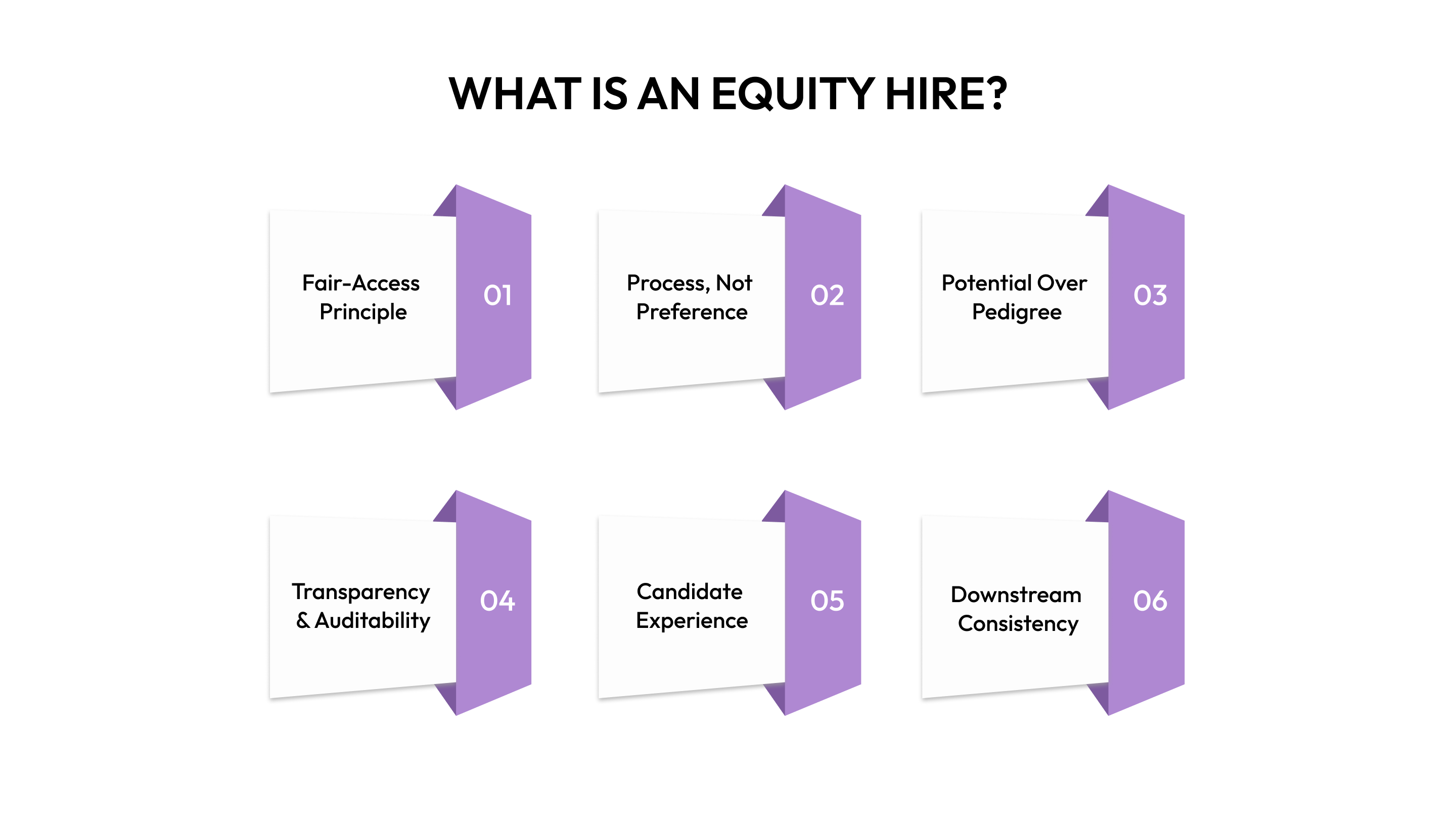
Core elements of an equity hire approach include:
- Fair-access principle: Open roles are marketed where qualified talent can actually see them (including community groups, HBCUs/MSIs, returnship programs, disability and veteran networks), expanding access beyond the usual circles.
- Process, not preference: Standardized job criteria, structured interviews, and calibrated scoring rubrics replace ad-hoc judgments, so comparable candidates are assessed against the same bar.
- Skill and potential over pedigree: Requirements emphasize demonstrable capabilities (work samples, job simulations, portfolio evidence) instead of proxies like school brand or last title.
- Transparency and auditability: Hiring teams document criteria, interview notes, and decisions; DEI and HR can review pipelines, pass-through rates, and offer parity to spot bias and course-correct.
- Inclusive candidate experience: Clear timelines, accessible interviews (e.g., captioning, alternate formats), and interviewer training reduce noise that can disproportionately disadvantage certain groups.
- Downstream consistency: Offers align to published pay bands, geo adjustments, and leveling guidelines, preventing pay compression and ensuring the new hire enters on equitable terms with peers.
Suggested read: A Comprehensive Guide to Startup Compensation and Equity
To see the impact of these practices, it’s important to understand the broader business and workforce benefits that equitable hiring brings.
Benefits of Equitable Hiring Practices
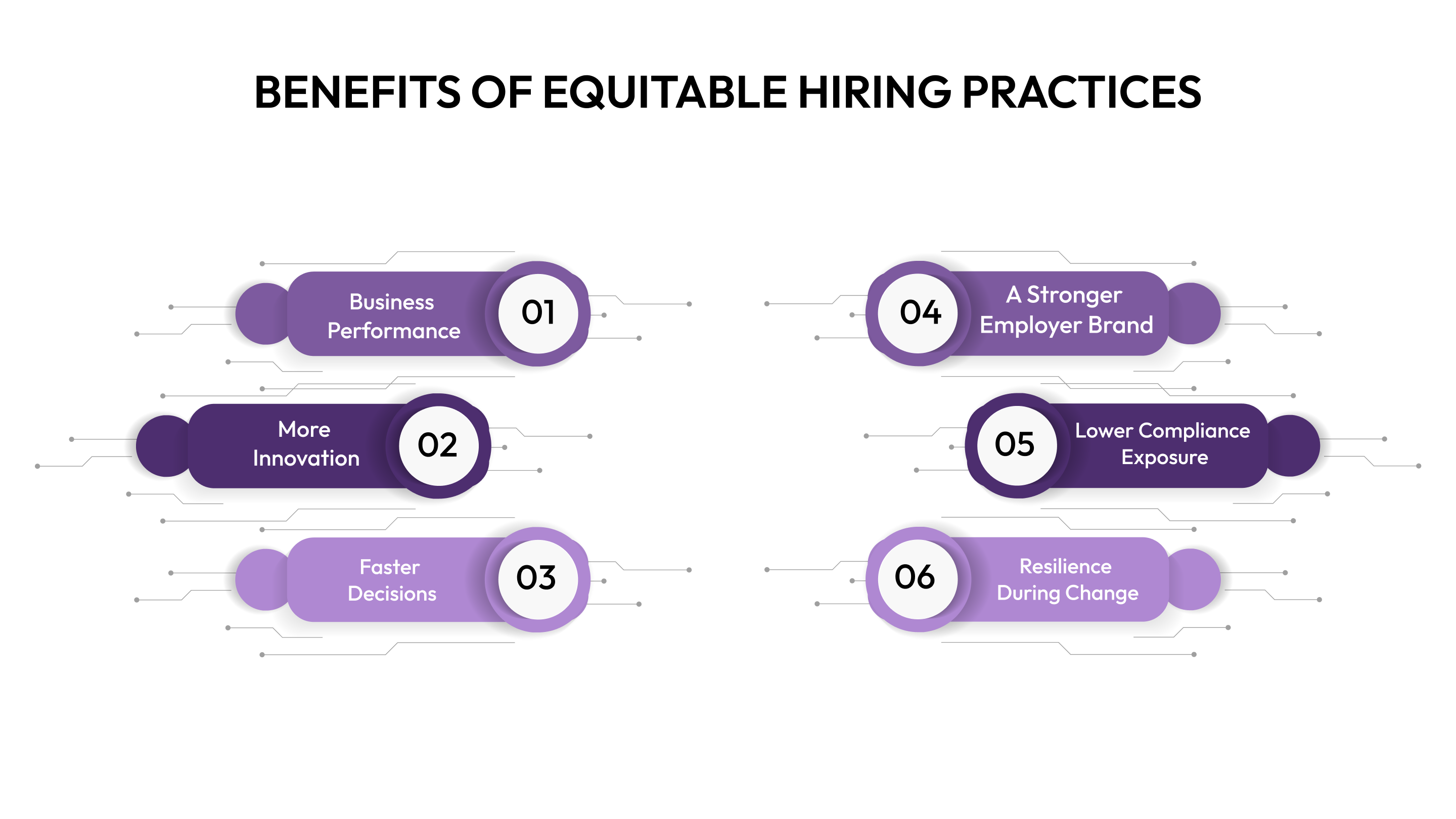
Equitable hiring is a set of choices that improve team quality, reduce risk, and strengthen long-term performance. Here’s what companies gain when they make equity part of how they hire:
- Better business performance at scale: Organizations with more diverse leadership are significantly more likely to outperform financially, a signal that fair access to opportunities upstream creates stronger teams downstream. Recent analysis shows companies in the top quartile for board gender diversity are 27% more likely to beat peers on financial results, with ethnicity effects now statistically significant as well.
- More innovation and growth pathways: When you widen the aperture on who gets hired and promoted, you increase cognitive variety. Empirical work links leadership diversity to higher innovation output and stronger EBIT margins, meaning hiring equity today shows up in tomorrow’s product mix and revenue.
- Higher-quality, faster decisions: Inclusive teams avoid groupthink. Studies of decision processes find that diverse groups make better business decisions up to 87% of the time and move faster with fewer meetings, an operational advantage that compounds as teams scale.
- A stronger employer brand and fuller pipelines: Candidates talk. Research tied to candidate experience shows that clear, fair processes reduce resentment and ghosting while improving how the market perceives your brand, which is critical in tight labor markets.
- Lower compliance exposure and cleaner audits: Equitable hiring, paired with consistent documentation, reduces the likelihood and cost of discrimination actions and aligns practices with enforcement priorities. The EEOC continues to secure multimillion-dollar remedies in pay and hiring cases, underscoring why fair, well-documented processes matter.
- Resilience during change: Broadening who gets considered for roles builds a deeper bench across geographies and backgrounds. That diversity of skills and perspectives improves adaptability when strategies, markets, or technologies shift, an effect reinforced by recent organizational research.
Knowing why equity matters is only half the journey. The real challenge lies in implementing hiring practices that make fairness a measurable reality.
.png)
Key Strategies to Implement Equity Hire in Recruitment
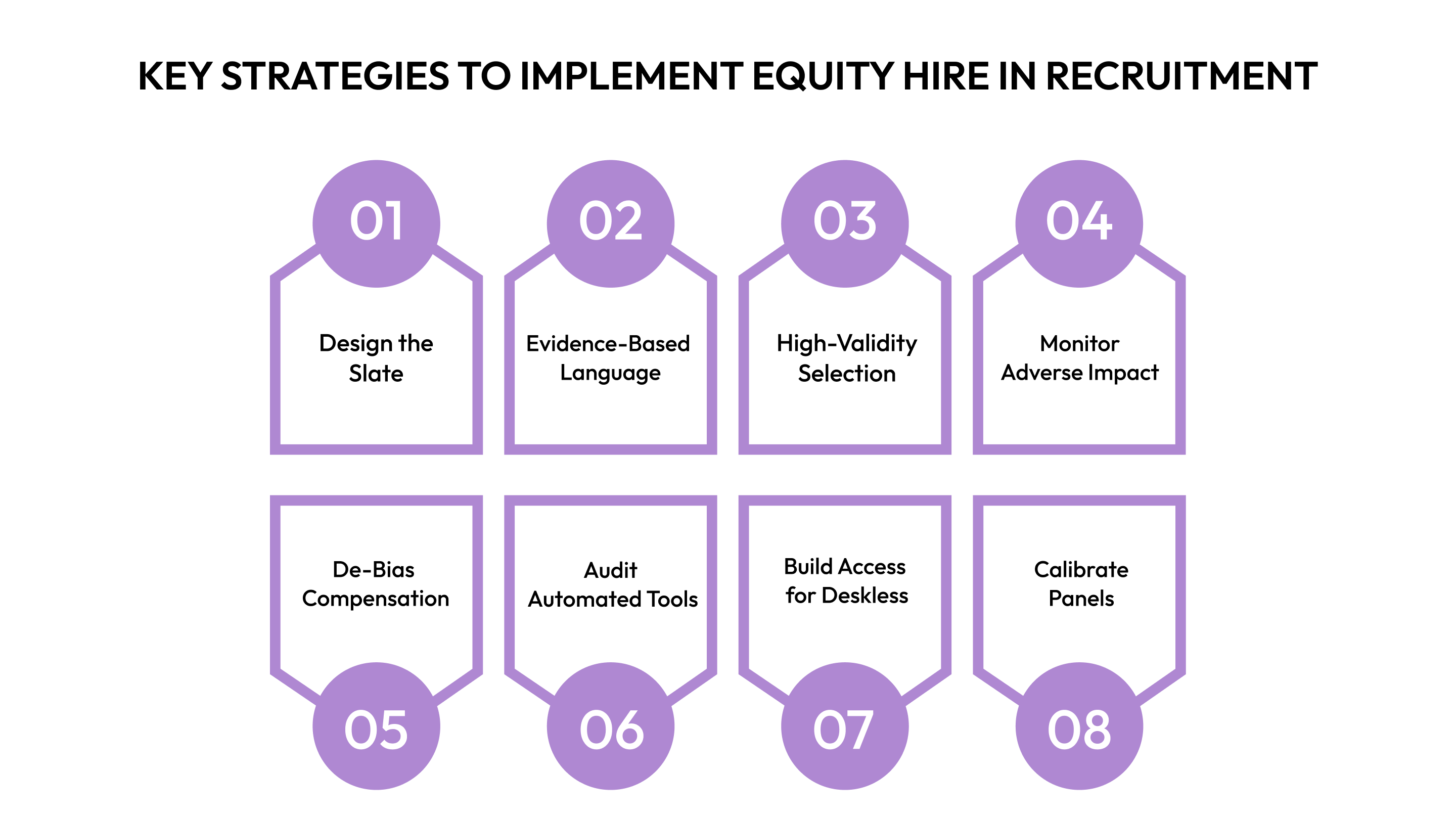
Implementing an equity hire approach requires more than posting inclusive language in a job ad. It demands intentional design, rigorous processes, and continuous measurement to ensure fairness is embedded at every stage. Here are strategies that go beyond the basics:
1) Design the Slate
When a finalist slate includes only one woman or one person from an underrepresented group, the odds of selection collapse toward zero, requiring at least two underrepresented candidates materially changes the decision dynamics and reduces token effects. Build this into your requisition checklist for director-and-above roles and any role with a historic imbalance.
Put it to work
- Policy: For every open role, require ≥2 underrepresented candidates at the finalist stage before scheduling executive interviews.
- Governance: Track exceptions and require a written rationale to avoid backsliding.
2) Rewrite Job Ads with Evidence-Based Language
Masculine-coded words (“dominant,” “rockstar,” “driven”) measurably reduce women’s interest in applying. Replace them with neutral, competence-focused phrasing and remove degree inflation where skills suffice. Back it with a short, validated competency list.
Put it to work
- Language audit: Run postings through a bias checker and map each requirement to a demonstrable skill.
- Degree reset: Where a degree is not job-critical, convert to “skill/experience equivalent,” aligning with the growing shift to skills-based hiring.
3) Use high-validity Selection Methods
Structured interviews, work samples, and validated assessments predict job performance far better than unstructured chats. Move to anchored rating guides, question banks tied to competencies, and practical job simulations; retire “culture fit” interviews.
Put it to work
- Interview kit: For each role, define 6–8 questions with behavioral anchors; require independent scoring before discussion.
- Work sample: Add a task representative of day-one work and score with a rubric.
4) Monitor Adverse Impact at Every Funnel Step
Instrument your pipeline like a product funnel: application → screen → onsite → offer. Calculate selection rates and the four-fifths (80%) rule for each protected group at each step; investigate where ratios fall short and A/B test fixes (e.g., different sourcing, new screen criteria). Document everything.
Put it to work
- Metrics: Selection rate, advancement rate, offer acceptance by group; review monthly with HR/Legal.
- Controls: Freeze changes that introduce adverse impact until remediated and re-tested.
5) De-bias Compensation Decisions before you Extend Offers
Ban reliance on prior pay and price candidates against bands using compa-ratio and experience evidence. Salary-history bans are associated with closing parts of the gender and racial pay gaps; in many jurisdictions, pay range disclosure in postings is now the law.
Put it to work
- Offer guardrails: Pre-approve ranges per level/geo; require written justification to exceed midpoints.
- Transparency: Publish salary ranges where required and keep internal guidance consistent across locations.
6) Audit Automated Tools and offer Human, Accessible Alternatives
If you use resume parsers, game-based tests, or video scoring, you own the outcomes. The EEOC has clarified that algorithmic tools used by employers can trigger Title VII and ADA obligations; NYC Local Law 144 requires annual bias audits and candidate notices for automated employment decision tools. Provide accommodations and a non-automated path on request.
Put it to work
- Vendor diligence: Obtain bias-audit results, validation studies, and adverse-impact reporting rights in contracts.
- Candidate notice & opt-out: Tell candidates what the tool assesses and how to request an alternative assessment.
7) Build Access for Deskless and Disabled Candidates by Design
Equity hire is about who can complete your process. DOJ/EEOC guidance warns that some screening tech can unlawfully “screen out” people with disabilities; provide clear accommodation pathways, mobile access, and low-bandwidth options.
Put it to work
- Accessibility pack: Offer alternative assessments, extended time, or human review on request; publish the process on every posting.
- Mobile-first: Support applications and assessments on phones for field roles and shift workers.
8) Calibrate Panels and Decisions
The biggest equity gains often arrive in how decisions are made: require independent scoring before group discussion, rotate panel composition, and run quarterly calibration sessions that compare scores to later performance to find systematic drift. This operationalizes the research on structured decision quality.
Put it to work
- Pre-read & blind notes: Collect scores/comments individually; reveal identities after scoring where feasible.
- Post-hire check: Compare interview ratings with 6–12-month performance to refine questions and anchors.
Also read: Issuing Equity to Candidates: What Public and Private Companies Need to Know
These strategies move beyond surface-level inclusion. By redesigning sourcing, standardizing evaluation, diversifying decision-makers, and continuously monitoring outcomes, organizations make equity hire a repeatable, high-integrity process that strengthens talent, culture, and business outcomes simultaneously.
Why CandorIQ is the perfect partner for your equitable hiring strategy
Even the best equity-focused recruitment practices can falter without alignment between hiring, compensation, and headcount planning. You might build a fair slate, structured interviews, and bias-aware assessments, but if your offer decisions, promotion paths, or pay bands don’t reflect those values, candidates (and existing employees) will see the gap.
CandorIQ fills that gap by turning your HR and hiring data into consistent, transparent, and equity-aligned decisions.
What CandorIQ brings to the table:
- Bias-aware Compensation & Payband Builder: CandorIQ allows you to define geo-adjusted pay bands and job-level ranges, ensuring that all new hires start with fair and consistent salaries regardless of location or background.
- Structured Offer Workflows: The platform manages candidate offers through transparent approval chains, records decision rationales, and includes guardrails to prevent disparities in pay or benefits.
- Total Rewards Visibility: CandorIQ provides candidates with a clear and comprehensive view of their total compensation package, including salary, bonuses, equity, and benefits, promoting transparency and trust.
- Headcount Scenario Planning: The system enables organizations to evaluate hiring decisions against budgets and team composition, helping prevent inequitable staffing or unbalanced representation across roles.
- Equity-focused Analytics: HR teams can track and report on pay parity, offer acceptance rates, and role distribution across demographics, identifying potential inequities before they become systemic.
- AI-powered Insights: CandorIQ uses AI to flag potential pay gaps, suggest equitable adjustments, and provide actionable decision support to maintain fair hiring outcomes at scale.
CandorIQ ensures your equity hires get fair and consistent offers, supports calibrated decision-making, and keeps everyone aligned from candidate to compass.
Conclusion
Adopting equitable hiring practices is a transformative approach that cultivates a diverse, inclusive, and high-performing workforce. By ensuring fairness in recruitment, organizations not only comply with ethical standards but also unlock a myriad of benefits, including improved financial performance, enhanced innovation, and a stronger employer brand.
To effectively implement and sustain these practices, leveraging data-driven insights is crucial. CandorIQ offers a platform that integrates compensation and workforce planning, providing the tools needed to make informed, equitable hiring decisions.
Ready to transform your hiring practices? Discover how CandorIQ can help you build a more equitable and effective workforce. Book a demo today.
FAQs
1. How can organizations prevent bias in referral programs?
Encourage diverse referral sources, anonymize candidate information where possible, and provide guidance to employees on referring talent from underrepresented groups.
2. What role does technology play in equitable hiring beyond HRIS?
Recruitment platforms and AI tools can standardize evaluations, track candidate progression, and provide analytics to identify gaps, but must be regularly audited for bias.
3. Can equity hire practices be applied to internal promotions?
Yes, applying the same principles—transparent criteria, structured evaluations, and pay-band alignment—ensures fairness in advancement decisions as well.
4. How do organizations handle cultural fit without biasing decisions?
Focus on culture add rather than fit, assessing how a candidate’s unique perspective contributes to the team instead of conforming to existing norms.
5. How often should hiring processes be reviewed for equity?
Organizations should review and audit recruitment and offer practices at least quarterly, ensuring criteria, scoring, and compensation remain fair and consistent.
Ready to modernize your workforce and compensation strategy?
See how CandorIQ brings workforce planning and compensation together with AI.