

How Does Employee Disengagement Impact Attrition? 9 Ways to Fix It
Employee disengagement impacts attrition by driving early exits. Learn how People Ops teams identify signals, predict risk, and plan headcount better.
.jpg)

Most attrition does not show up where you expect it to. By the time a resignation hits your report, the underlying issue has already played out somewhere else: in manager conversations, compensation decisions, or unclear growth paths.
For People Ops teams, that creates a structural gap. You are tracking exits, but the signals that drive them occur outside your core reporting systems.
Employee disengagement impacts attrition by driving exits months before resignations occur, making attrition a lagging indicator rather than a real-time signal. Understanding this helps People Ops teams connect early disengagement signals to workforce outcomes, so attrition stops being a surprise and becomes predictable.
In this blog, we break down where those signals come from, how they evolve, and how to act on them before they impact your headcount plan.
Key Takeaways
- Employee disengagement impacts attrition by driving exits months before resignation, making attrition a lagging indicator of workforce risk.
- Disengagement caused by poor management, unclear compensation, limited growth, and role misalignment increases voluntary and regrettable attrition.
- Early behavioral signals of disengagement allow People Ops teams to identify attrition risk before it shows up in exit data.
- Disengagement-driven attrition leads to higher hiring costs, productivity loss, and disruption in headcount planning.
- Connecting engagement signals to workforce planning enables teams to predict attrition risk and adjust hiring and budget decisions in advance.
What Is Employee Disengagement?
Employee disengagement is the gradual loss of emotional investment in one's role, team, and organization. The employee still shows up. Tasks still get completed. But they have stopped caring about outcomes beyond the minimum required.
Engagement exists across three distinct states, each with a different impact on team performance:
In 2024, Gallup reported that only 31% of US employees were engaged at work, the lowest level in a decade. Globally, that number fell further to 20% in 2025, the lowest recorded since 2020. That means four in five employees worldwide are somewhere between not engaged and actively checked out. In the US alone, disengaged and not-engaged workers account for an estimated $1.9 trillion in annual lost productivity.
Attrition vs. Turnover: Why the Difference Matters for Headcount Planning
These two terms get used interchangeably, but they describe different situations with different planning implications.
When disengagement is the driver, you typically see attrition rather than turnover because People Ops is often unaware that an employee was at risk until after the resignation is submitted.
People Ops teams need to track three types of attrition separately, because each carries a different planning implication:
- Voluntary attrition: The employee chooses to leave. Most directly tied to disengagement and the most preventable.
- Involuntary attrition: The organization initiates the exit through layoffs, restructuring, or performance-related separations.
- Regrettable attrition: High performers or hard-to-replace roles who exit before the organization is ready. This is where disengagement does its most expensive damage.
What Causes Employee Disengagement?
Disengagement rarely starts with a single event. It builds quietly from unresolved friction, such as missed growth, unclear expectations, or inconsistent feedback.
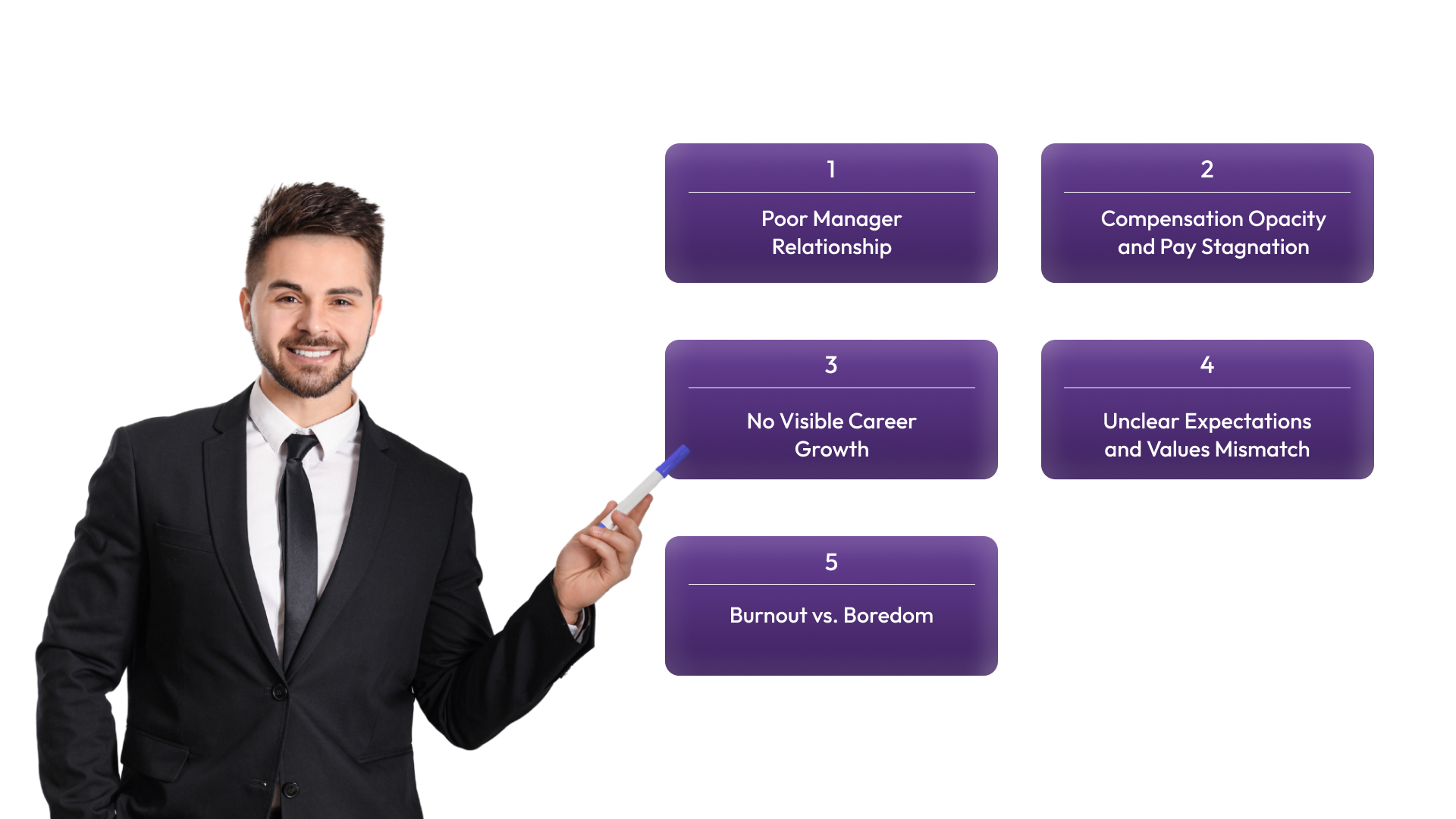
That friction usually shows up in a few consistent patterns across teams:
Poor Manager Relationship
Managers account for 70% of the variance in employee engagement levels, according to Gallup. Poor direction, absent feedback, and a lack of recognition from a direct manager are the most reliable disengagement triggers in any organization.
A team member who was vocal and proactive six months ago and is now consistently silent is showing a behavioral shift. Nine times out of ten, a manager relationship is at the root of that change.
Compensation Opacity and Pay Stagnation
Pay is not always about the absolute number. It is about fairness and clarity. An employee who does not know where they sit in their pay band, has no visibility into what progression looks like, or suspects a new hire came in at a higher rate, will disengage before starting a job search. The resentment builds quietly. Transparent pay structures with visible growth paths reduce the comparisons that accelerate Stage 1 disengagement.
No Visible Career Growth
LinkedIn’s 2025 Workplace Learning Report shows that companies actively promoting career development track retention more closely and report stronger retention outcomes, compared with organizations that invest less in learning and growth opportunities. When employees cannot see a credible next step inside the organization, they start looking for one outside it.
This is especially common in fast-scaling companies where roles get created reactively, growth paths are informal, and employees realize the only way to progress is to leave.
Unclear Expectations and Values Mismatch
About 14% of disengaged employees point to unclear role expectations as their primary trigger, and 23% cite a mismatch in organizational values. When employees cannot connect their daily work to something meaningful or understand what success looks like in their role, motivation erodes steadily.
Burnout vs. Boredom: Two Different Problems
Burnout and boredom are both disengagement triggers, but they require opposite responses. A burned-out employee needs workload relief. A bored employee needs a broader scope and more challenges. Applying the wrong fix makes both situations worse.
Telling a burned-out employee they need more responsibility accelerates their exit. Telling a bored one to slow down does the same. Boredom-driven disengagement is systematically underdiagnosed because it does not show up in absenteeism data. It shows up in the slow erosion of initiative, and then in a resignation that surprises everyone.

Early Warning Signs of Disengagement Most Managers Miss
Disengaged employees continue to show up, which is exactly why the early signals go unnoticed. Taken together, these patterns form a clear picture worth acting on before the employee reaches Stage 3.
Withdrawal from Team Activities
Disengaged employees distance themselves from professional and social interactions. They stop participating in meetings, avoid collaborative projects, and pull back from peer engagement. Their absence creates a ripple effect, as collaboration and camaraderie are key drivers of the team's overall output. The key distinction is that this is a shift from their own previous baseline, not a personality trait.
Disappearing Initiative
Initiative is a discretionary behavior. People stop spending it when they stop caring about outcomes. A disengaged employee waits for instructions rather than identifying opportunities. They complete what is assigned, and nothing more. This is one of the earliest and most telling signals because it appears well before output quality drops.
Declining Output Quality
Deadlines start slipping slightly. Errors appear more often. The employee is still present, but their contribution has fallen below their historical standard, often resulting in a heavier workload for the rest of the team.
Cynicism Toward Leadership and Initiatives
Disengaged employees often show skepticism about new decisions or communicate with sarcasm and disinterest. This matters because it spreads. McKinsey research found that disruptive employees create a vicious cycle that reinforces disengagement and harms higher-performing teammates.
Reduced Emotional Investment
The most significant signal is a loss of emotional involvement. Disengaged employees no longer care about the company's goals or their role within them. They stop seeking growth, stop improving, and disengage from anything beyond the transactional. This detachment affects performance, relationships, and eventually the broader culture.
The Stages of Employee Disengagement and Where the Intervention Window Closes
Disengagement is not a single event. It is a process. Where an employee sits in that process determines how much time you have to intervene and what kind of intervention will work.
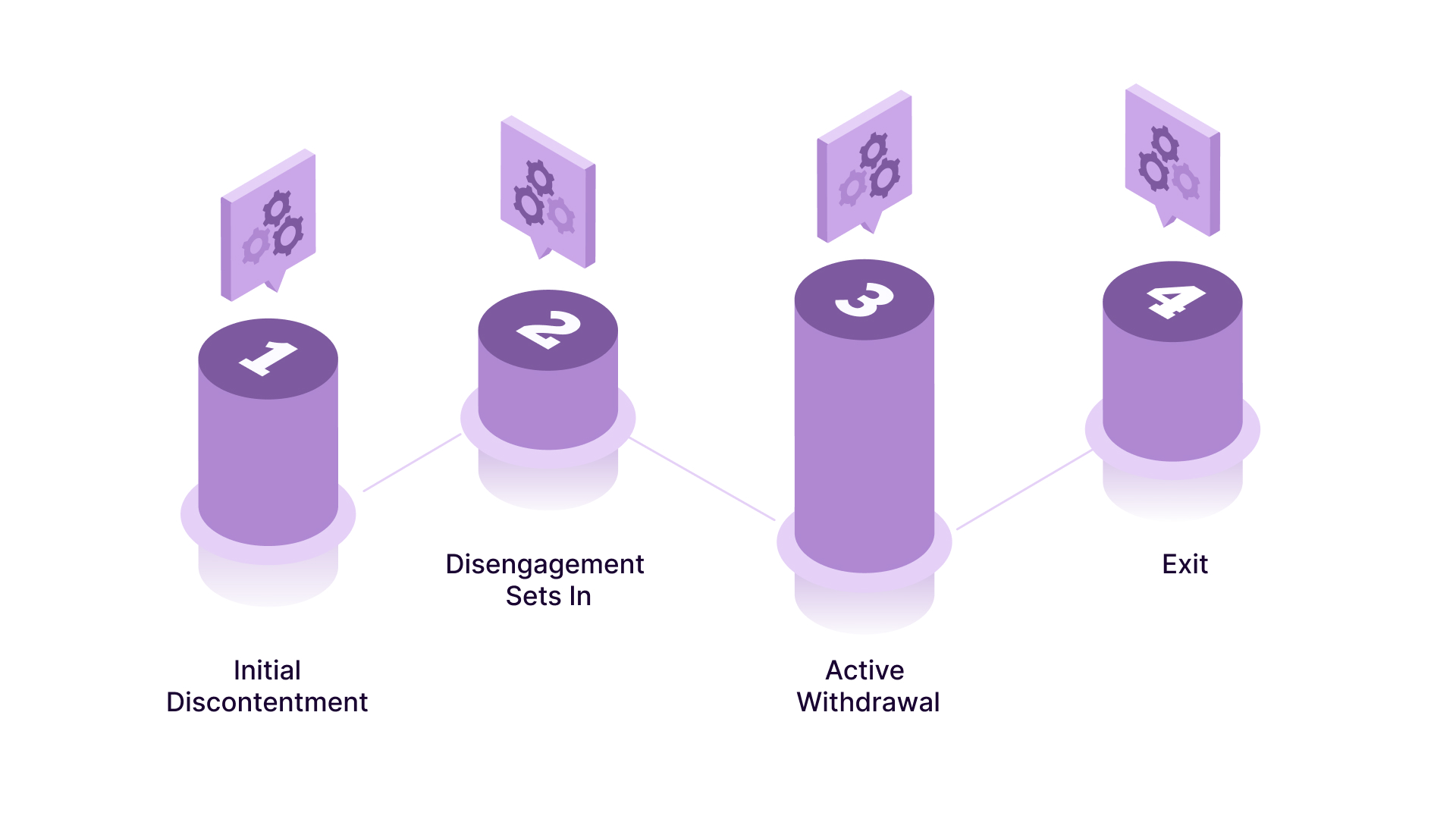
Stage 1: Initial Discontentment
Something disrupts the employee's experience. A failed promotion, a compensation review that fell short, a shift in manager, a company decision they disagree with. They are still engaged overall, but a seed of dissatisfaction has been planted.
- Attrition risk: Low. A direct conversation with a credible response can resolve it.
- Signal to watch: Lower participation in team discussions, minor complaints about specific decisions, and less energy in 1:1s than their previous baseline.
- What People Ops misses: This stage almost never shows up in performance data. Output is fine. The signal lives only in the manager's observations.
Stage 2: Disengagement Sets In
The dissatisfaction was not addressed, or the response was not credible. The employee starts reducing their discretionary investment. Work still gets done, but initiative, enthusiasm, and above-and-beyond effort are gone.
- Attrition risk: Moderate to high. The employee is likely passively job-searching, or at least open to a conversation with a recruiter.
- Signal to watch: Procrastination on non-urgent tasks, declining pulse survey scores, pulling back from cross-functional work, and reduced engagement in performance conversations.
- Intervention window: This is where annual engagement surveys fall short. By the time results are analyzed and shared, Stage 2 has often progressed to Stage 3. Monthly pulse surveys with visible follow-through catch it in time.
Stage 3: Active Withdrawal
The employee has mentally decided to leave. They have not made the external move yet, but they are limiting their organizational footprint by avoiding responsibilities, disengaging from team relationships, and showing up only to do the minimum.
- Attrition risk: High. Reversal requires a concrete change in circumstances, not just a conversation.
- Signal to watch: Camera off in all meetings with no contribution, declining invitations, and no participation in development conversations.
Stage 4: Exit
The employee resigns. By this point, the organizational cost is already accumulating. The team has absorbed the productivity gap, morale has been affected, and the hiring process has not started yet.
Exit interview data at this stage is almost always polished and diplomatic. The real trigger happened in Stage 1 or Stage 2, months earlier. Diagnosing attrition from exit interviews is like reviewing a crash report to prevent the accident.
The 6-Month Rule: In most cases, disengagement leading to attrition began 6 to 12 months before the resignation. By the time it shows up in attrition data, the intervention window for that employee has already closed. The goal is to catch Stage 1 and Stage 2, not Stage 4.
Suggested Read: Workforce Optimization Strategies to Maximize Productivity
The Ripple Effect of Disengagement on Teams and Culture
When signs of disengagement go unaddressed, the consequences extend well beyond a single employee. The cumulative effect on team performance and organizational health is damaging in ways that standard attrition reports do not capture.
Loss of Team Morale
When disengagement spreads, it affects the team's overall morale. A disengaged individual subtly influences those around them, leading to a collective drop in enthusiasm and productivity. McKinsey research indicates that actively disengaged employees can act as ‘cranky force multipliers,’ significantly damaging morale and undermining the performance of even the strongest colleagues around them.
Decreased Organizational Commitment
Disengaged employees are less likely to speak positively about the company externally. This damages employer branding over time. Candidates research company culture, read reviews, and speak with current or former employees. An organization known for a disengaged workforce faces greater difficulty attracting top talent, especially in competitive hiring markets.
Increased Risk of Further Attrition
The most immediate consequence of disengagement is higher attrition. When employees feel disconnected from their work, they explore opportunities that offer a greater sense of purpose or recognition. Seeing peers leave, especially when those exits are clearly driven by dissatisfaction, causes remaining employees to question their own situation. The strongest performers, who have the most market options, are usually the first to act on that question.
How Disengagement Shows Up in Attrition Patterns?
Research consistently shows that engaged employees are 2.5 times more likely to remain with their organization than disengaged colleagues. The mechanism is direct: when employees disengage, they stop feeling anchored to their role. Compensation stops feeling proportional to effort. Career growth feels stalled. The cost of staying eventually outweighs the friction of leaving.
For People Ops, the impact shows up in three patterns:
- Voluntary resignation rates increase, particularly in tenured roles that entail embedded knowledge, client relationships, or team influence.
- Early tenure exits occur when disengagement sets in during onboarding or in the first 90 days due to a mismatch between what was promised and what the role actually entails.
- Cluster exits, where one disengaged employee who leaves takes social capital with them, and others with similar frustrations follow within one to two quarters.
The Financial and Operational Cost of Attrition
According to SHRM, the average cost to replace an employee ranges from 50% to 60% of their annual salary, depending on role and seniority. That figure understates the real cost because most organizations never account for the pre-exit productivity drain, the output lost from Stage 2 onward, before the resignation lands.
Beyond the direct cost, attrition from disengagement creates three operational problems that compound over time.
- Team disruption: When key employees leave, others absorb the workload. Increased workload on remaining employees is one of the fastest paths to secondary disengagement.
- Knowledge gaps: Experienced employees take their expertise with them. Rebuilding that knowledge can take months or years, with a direct impact on project delivery and client relationships.
- Cascade exits: Seeing peers leave, especially when those departures are clearly driven by dissatisfaction, makes remaining employees question their own commitment. The strongest performers, who have the most options, act on that question first.
Suggested Read: Best All-in-One Workforce Management Software 2025

Why Disengagement Is a Headcount Planning Problem?
Most organizations treat disengagement as an HR conversation. It stays inside People Ops. Finance and workforce planning never see it coming. By the time it shows up in attrition data, the headcount plan is already wrong.
A company builds a headcount plan assuming 8% voluntary attrition. Engagement has been declining quietly for two quarters in one function. Actual voluntary attrition in that function runs at 15%. The result: unbudgeted backfills, roles sitting open for 60-plus days, and replacement hires entering at pay levels above the original pay band. None of this appears in any report labeled disengagement cost. It shows up as a budget variance.
The organizations that get ahead of this connect engagement signals to their headcount planning cycle. When engagement data suggests elevated attrition risk for a specific team or function, the headcount plan for that group should reflect a higher attrition scenario before exits occur, not after. That shift positions People Ops as a genuine planning partner for Finance rather than a reporting function that delivers bad news after the fact.
Top 9 Strategies to Reduce Disengagement and Attrition
Addressing disengagement requires structural changes, not one-off programs. The strategies below are directly tied to the root causes above and are designed for People Ops teams responsible for real workforce planning.
1. Replace Annual Surveys with Continuous Pulse Systems
Annual engagement surveys fail because they capture sentiment too late. By the time trends are visible, disengagement has already compounded into attrition risk.
Move to a monthly pulse system that tracks a fixed set of dimensions:
- Manager effectiveness
- Career progression visibility
- Compensation clarity
- Workload sustainability
- Role clarity and purpose
Keep surveys short, consistent, and comparable month over month.
Operationally, this only works if paired with a response system. After each cycle:
- Identify the highest-risk dimension at the org or team level.
- Assign ownership to a People Ops or functional leader.
- Define one corrective action within 30 days.
- Communicate back to employees what changed.
This creates a closed feedback loop where employees see cause and effect between input and action.
2. Build and Expose a Structured Compensation Framework
Disengagement around pay is driven more by uncertainty than by the number itself. Employees disengage when they cannot model their future inside the organization.
To fix this, compensation needs to be structured and visible:
- Define pay bands for each role and level.
- Document what progression within a band looks like.
- Clarify what triggers movement (performance, tenure, scope).
- Standardize how offers for new hires are benchmarked.
Then make this information accessible, not hidden in HR systems.
In parallel, align compensation discussions with performance cycles so employees understand:
- Where they currently sit
- What is the next milestone?
- What timeline is realistic
This reduces speculation and prevents silent comparison loops that lead to disengagement.
3. Instrument Manager Quality and Tie It to Outcomes
Manager effectiveness is the highest-leverage variable in engagement, but it is rarely measured with the same rigor as other business metrics.
Build a system where manager quality is continuously evaluated using:
- Upward feedback (quarterly).
- Team-level engagement scores (monthly).
- Attrition and internal mobility data.
The key is not just collecting this data, but correlating it.
For example:
- A drop in engagement + high attrition within one team is not random.
- It is a signal tied to a specific manager environment
Operationally:
- Flag managers in the bottom quartile of feedback scores
- Require targeted intervention plans (coaching, restructuring, or role change)
- Review manager metrics alongside business performance.
This shifts the quality of managers from a subjective conversation to a measurable input.
4. Systematize Stay Interviews as a Data Source
Exit interviews explain past attrition. Stay interviews predict future attrition.
Run structured stay interviews at critical tenure points (typically 12–24 months), where employees are most likely to reassess their position.
Standardize a small set of questions:
- What would make you stay here for the next two years?
- What feels misaligned in your current role?
- Where do you feel blocked in growth?
The value is not in collecting answers, but in how they are used.
Aggregate responses across teams and feed them into:
- Compensation planning.
- Role design and scope adjustments.
- Promotion and internal mobility decisions.
This turns qualitative feedback into input for workforce planning, rather than isolated conversations.
5. Integrate Engagement Signals into Headcount Planning
Most workforce plans rely on historical attrition averages, which assume a stable environment. Disengagement breaks that assumption.
Instead, integrate real-time engagement data into planning models.
For each function:
- Map engagement trends over the last 2–3 quarters.
- Identify teams with consistent decline.
- Adjust projected attrition ranges accordingly.
Example:
- Historical attrition: 8%
- Low engagement team: model 13–15%
Then reflect this in:
- Hiring plans.
- Budget allocation.
- Backfill timelines.
This prevents reactive hiring and aligns Finance and People Ops around realistic workforce risk.
6. Make Career Growth Tangible and Verifiable
Career frameworks fail when they exist only as documentation. Employees disengage when growth feels hypothetical.
To make growth credible:
- Define clear role progressions with skill and scope expectations.
- Map internal mobility paths across functions where relevant.
- Highlight real examples of employees who have progressed.
Managers should be able to answer, concretely:
- What is the next role for this person?
- What needs to change for them to get there?
- What is the expected timeline?
This shifts career growth from abstract promise to visible pathway.
7. Diagnose Disengagement Before Prescribing a Fix
Disengagement is not a single condition. Burnout and boredom require opposite interventions, and misdiagnosis accelerates attrition.
Embed a simple diagnostic into manager 1:1s:
- Is the issue energy-related (fatigue, overload)?
- Or motivation-related (lack of challenge, stagnation)?
Then align the response:
- For burnout → reduce workload, rebalance priorities.
- For boredom → expand scope, introduce new challenges
This ensures interventions match the actual cause rather than applying generic engagement programs.
8. Redesign Onboarding as an Engagement System
Disengagement often begins within the first 90 days when expectations set during hiring do not match reality.
To prevent this:
- Structure onboarding into 30-60-90 day milestones.
- Assign mentors or peer guides.
- Track early engagement signals through short check-ins.
Focus on alignment:
- Does the role match what was promised?
- Does the employee understand success expectations?
- Is the manager relationship forming correctly?
Early correction here prevents long-term disengagement patterns.
9. Operationalize Mental Health Support
Burnout-driven disengagement cannot be addressed solely through workload adjustments. It requires accessible mental health support integrated into daily work environments.
Effective programs include:
- Easy access to counseling or support services.
- Clear communication on how to use them.
- Manager awareness to guide employees toward support.
The key is usability. Support systems only impact engagement if employees can access them without friction or stigma.
Suggested Read: AI-Driven Workforce Optimization: Enhancing Management and Productivity
How CandorIQ Helps People Ops Teams Get Ahead of Attrition?
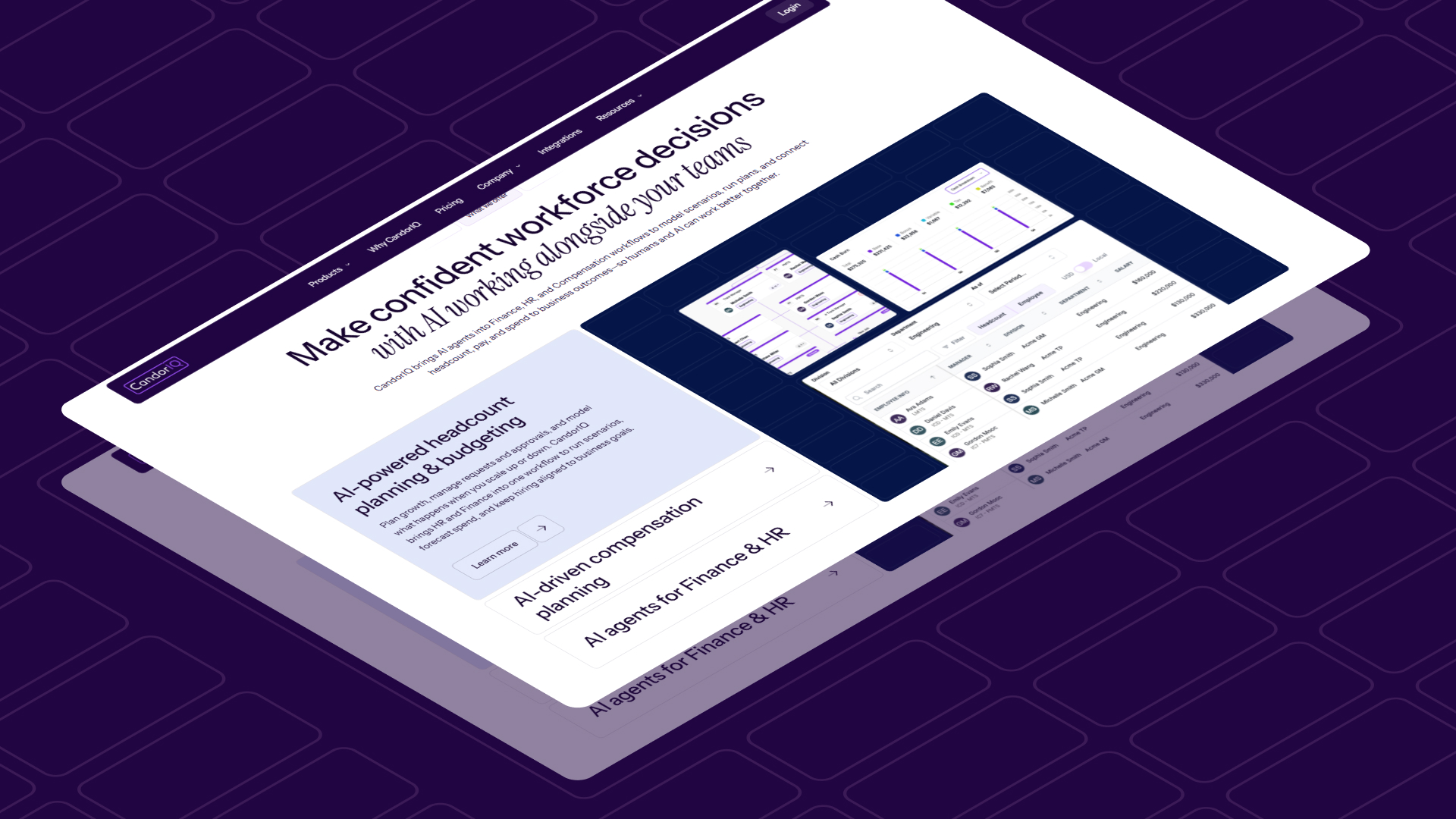
Managing compensation and headcount planning manually often leads to visibility gaps and inconsistent decisions. When disengagement signals sit in HR tools while attrition costs land in Finance, People Ops is always catching up rather than planning ahead.
CandorIQ is a workforce planning and compensation platform designed to help teams manage pay bands, compensation cycles, and headcount planning in a single unified system. Here is where it directly connects to the disengagement and attrition problem:
- Compensation and Payband Builder: Define pay structures by level, role, and location. Gives employees clear visibility into where they sit and what growth looks like, directly addressing the pay opacity that drives Stage 1 disengagement.
- Compensation Cycle: Run merit and bonus reviews with real-time budget tracking and structured approval workflows. Consistent, explainable compensation decisions reduce the resentment that builds during disengagement.
- Headcount Scenario Planning: Model attrition scenarios and their financial impact before they hit the budget. If engagement data signals elevated risk in a specific function, the headcount plan can reflect that before the exits happen.
- Workforce Management: Track open roles, attrition actuals, and headcount plan versus actual in one shared view. Gives People Ops and Finance the same data rather than competing spreadsheets.
- AI Agent: Ask natural language questions about workforce trends, surface attrition patterns by team or tenure cohort, and model cost scenarios without waiting on an analyst.

FAQs
1. How can People Ops quantify the impact of disengagement on attrition risk?
People Ops can quantify disengagement impact by correlating engagement scores, manager feedback, and tenure data with attrition trends to identify patterns and forecast risk across teams.
2. Which teams are most vulnerable to disengagement-driven attrition?
High-growth teams, newly structured functions, and teams under inconsistent management are most vulnerable, as unclear roles, shifting expectations, and a lack of stability accelerate disengagement and increase attrition risk.
3. How often should organizations reassess disengagement risk across teams?
Organizations should reassess disengagement risk monthly using pulse data and quarterly through deeper analysis, ensuring early signals are captured before they translate into attrition and planning disruptions.
4. What role does leadership communication play in preventing disengagement-related attrition?
Clear and consistent leadership communication reduces uncertainty, aligns expectations, and reinforces trust, which helps prevent disengagement from escalating into attrition driven by confusion, misalignment, or perceived instability.
5. Can disengagement-driven attrition be reversed once employees start job searching?
Disengagement-driven attrition can be reversed in early stages if underlying issues are addressed quickly, but once active job searching begins, recovery becomes significantly harder and less predictable.
Ready to modernize your workforce and compensation strategy?
See how CandorIQ brings workforce planning and compensation together with AI.